[ Film / Synopsis ]
Two filmmakers attempt a century-spanning feature alone, documenting every compromise between ambition, limited hardware, and the human hours they cannot automate.
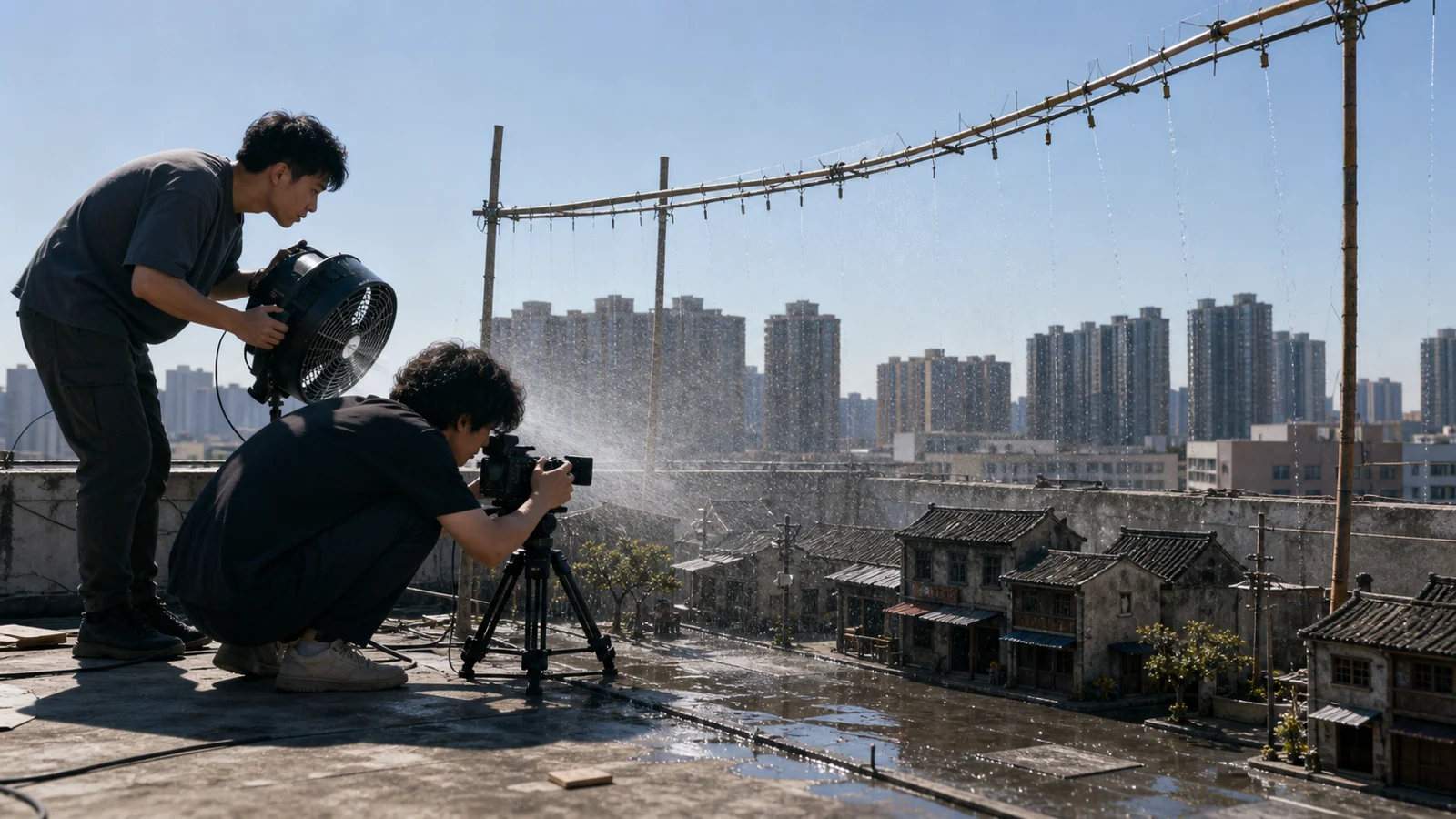
Filmmakers Luo Yimeng and Gao Zhiwei set out to make a family chronicle spanning 1926 to 2026 using a two-room workspace, locally operated systems, practical props, and no additional crew. Their documentary follows the production rather than presenting the finished chronicle alone. Costume continuity lives on a wall of printed cards; miniature rooms are scanned and rebuilt across decades; performers are the filmmakers themselves, transformed only within predeclared roles. Each chapter reveals a different bottleneck, from maintaining faces across ageing states to recovering a corrupted edit and rebuilding a street sequence after memory limits collapse. The film’s strongest moments are deliberately ordinary: cooling hardware, recording footsteps after midnight, rejecting an attractive shot that breaks character history. By exposing schedule, energy use, failed outputs, and manual repair, the partnership turns workflow into a dramatic subject and a plausible model for independent feature production.
“For proving that a two-person team can sustain feature-scale ambition through a clear, reproducible workflow without concealing labour, limits, or creative compromise.”International Jury citation
- Director
- Luo Yimeng · Gao Zhiwei
- Production entity
- Daylight Pair Cinema
- Entity type
- Two-person filmmaking partnership
- Country / region
- China
- Runtime
- 74 min
- Language
- Mandarin
- Format
- 4K · 1.78:1 · 5.1 mix
- Genre
- Production-process documentary feature
- Completed
- 24 June 2026
- Production window
- 19 months
- Festival master / version
- Festival master v3.0 · checksum locked
[ Named authorship / Principal credits ]
Creative team
[ Production entity / Profile ]
Daylight Pair Cinema
Daylight Pair Cinema is the two-person filmmaking partnership of Luo Yimeng and Gao Zhiwei. They design locally reproducible feature workflows in which every automated step can be paused, inspected, and replaced by a manual method.
[ 51% Standard / Assessed creative participation ]
84%
AI participation is assessed across the full chain of authorship, supported by journals, model logs, version histories, stems and finishing records.
[ Capability record / 2026 signal ]
Where this film points
- Local reproducible pipeline
- Long-horizon consistency
The film demonstrates a feature workflow that two people can operate, inspect, and rebuild on local hardware. It predicts independent production value shifting from tool access to disciplined continuity and recoverable process design.
The two filmmakers alone carried the physical labour, performance, narrative judgment, and decision to abandon shots that exceeded their resources.
[ Night Shift, Year Seventy ]
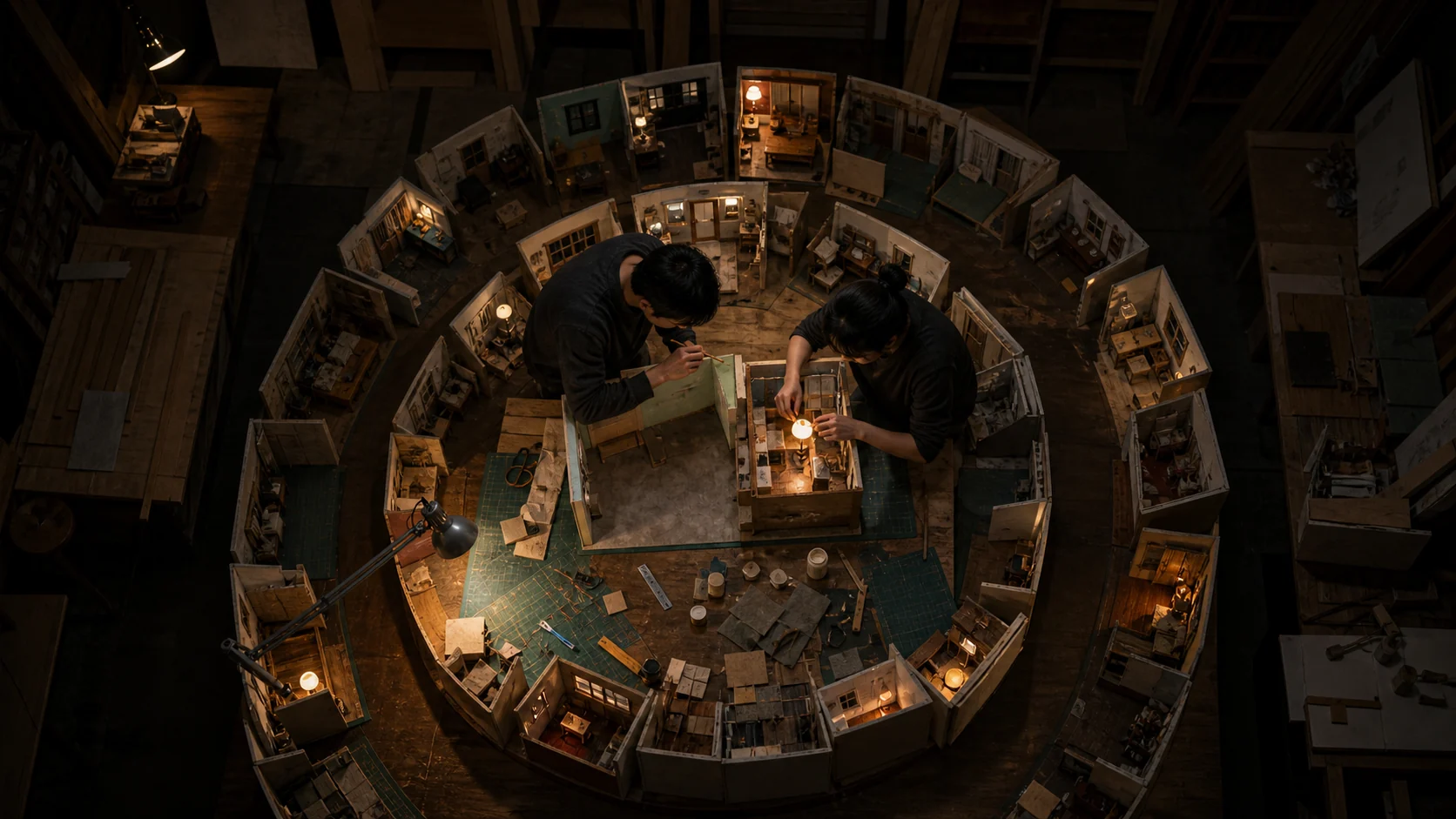
The pair rebuilds a miniature apartment while an ageing continuity chart fills the wall behind them. A failed render remains visible on a small monitor.
[ Production method / Documented workflow ]
How the film was made
The record distinguishes authored decisions, bounded machine operations and final human approvals across the production chain.
The pair converted a century timeline into scene cards, character states, and dependency checks that could run locally and export as plain files.
Both filmmakers performed all roles under declared transformation scopes, using practical eyelines and repeatable motion cues to preserve scene geography.
Miniature scans, self-shot plates, local generation, seed locking, and shot recipes produced repeatable decades within limited computing capacity.
Proxy-first editing and versioned shot manifests let either partner rebuild a sequence without relying on hidden project state.
The pair recorded all Foley and room tone, then used local separation and restoration processes with recoverable settings.
They archived scripts, shot recipes, seeds, permissions, local components, energy logs, failure notes, and rebuild instructions with the master.
“For proving that a two-person team can sustain feature-scale ambition through a clear, reproducible workflow without concealing labour, limits, or creative compromise.”
[ Records / Rights / Provenance ]
Reviewer-ready evidence
The record connects every scene to its script state, practical source, shot recipe, failed attempts, and final decision.
Self-performance, borrowed props, locations, textures, and source materials have defined uses, durations, and withdrawal procedures.
Local component lineage, adapters, licensed sources, seeds, settings, hardware profiles, and replacement paths are preserved.
The package contains the feature master, mix, subtitles, access files, plain-file manifests, rebuild guide, and checksum record.