[ Film / Synopsis ]
During a refinery evacuation, a theatre audience decides which testimony reaches the emergency broadcast before the city loses power.
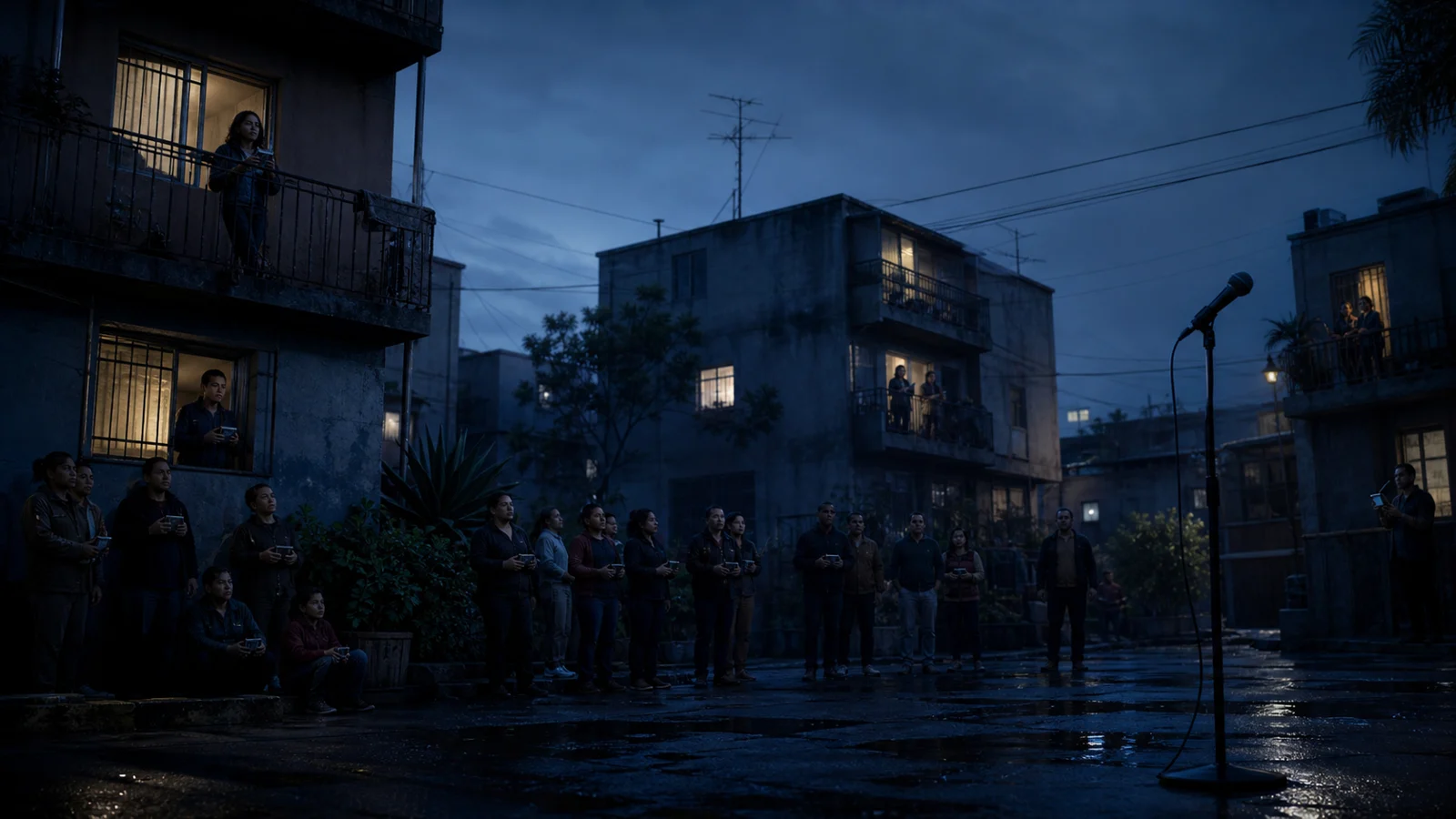
A border-region refinery has caught fire, the electrical grid is failing, and a temporary radio desk can transmit only three of nine witness accounts. In the theatre, viewers jointly decide which testimony the onscreen broadcasters pursue: a night guard who saw the first flash, a family searching for an asthmatic child, a company driver carrying an unsigned manifest, or residents already organising shelter. Every branch was written and performed as a complete dramatic path. A local inference system selects pacing, point of view, and previously filmed responses within constraints approved by the writers; it cannot invent dialogue or replace actors. The audience gradually learns that attention itself redistributes risk. No route solves the emergency, and no single witness owns the whole account. The thriller’s urgency comes from competing obligations, bilingual misunderstandings, and the shrinking minutes before the final transmitter falls silent.
“For making collective choice dramatically legible, ethically bounded, and emotionally consequential without reducing civic conflict to a mere branching novelty.”International Jury citation
- Director
- Tessa Valejo
- Production entity
- Civic Ember Narrative Lab
- Entity type
- University narrative systems laboratory
- Country / region
- United States · Mexico
- Runtime
- 58–92 min
- Language
- English · Spanish
- Format
- 4K interactive playback · 2.00:1 · 5.1 mix
- Genre
- Interactive civic thriller
- Completed
- 10 June 2026
- Production window
- 15 months
- Festival master / version
- Festival runtime v1.6 · checksum locked
[ Named authorship / Principal credits ]
Creative team
[ Production entity / Profile ]
Civic Ember Narrative Lab
Civic Ember Narrative Lab is a university-based research group focused on collective decision structures for live cinema. Its productions separate authored performance material from runtime assembly and publish clear boundaries for audience data.
[ 51% Standard / Assessed creative participation ]
76%
AI participation is assessed across the full chain of authorship, supported by journals, model logs, version histories, stems and finishing records.
[ Capability record / 2026 signal ]
Where this film points
- Agentic narrative systems
- Long-horizon consistency
The work demonstrates narrative agents mature enough to manage feature-scale state while remaining inside fully authored evidence. It forecasts interactive cinema sold as accountable dramaturgy rather than unlimited improvisation.
Writers and performers alone decided the ethical equivalence of branches and the emotional consequences of withholding each testimony.
[ Three Voices Before Blackout ]
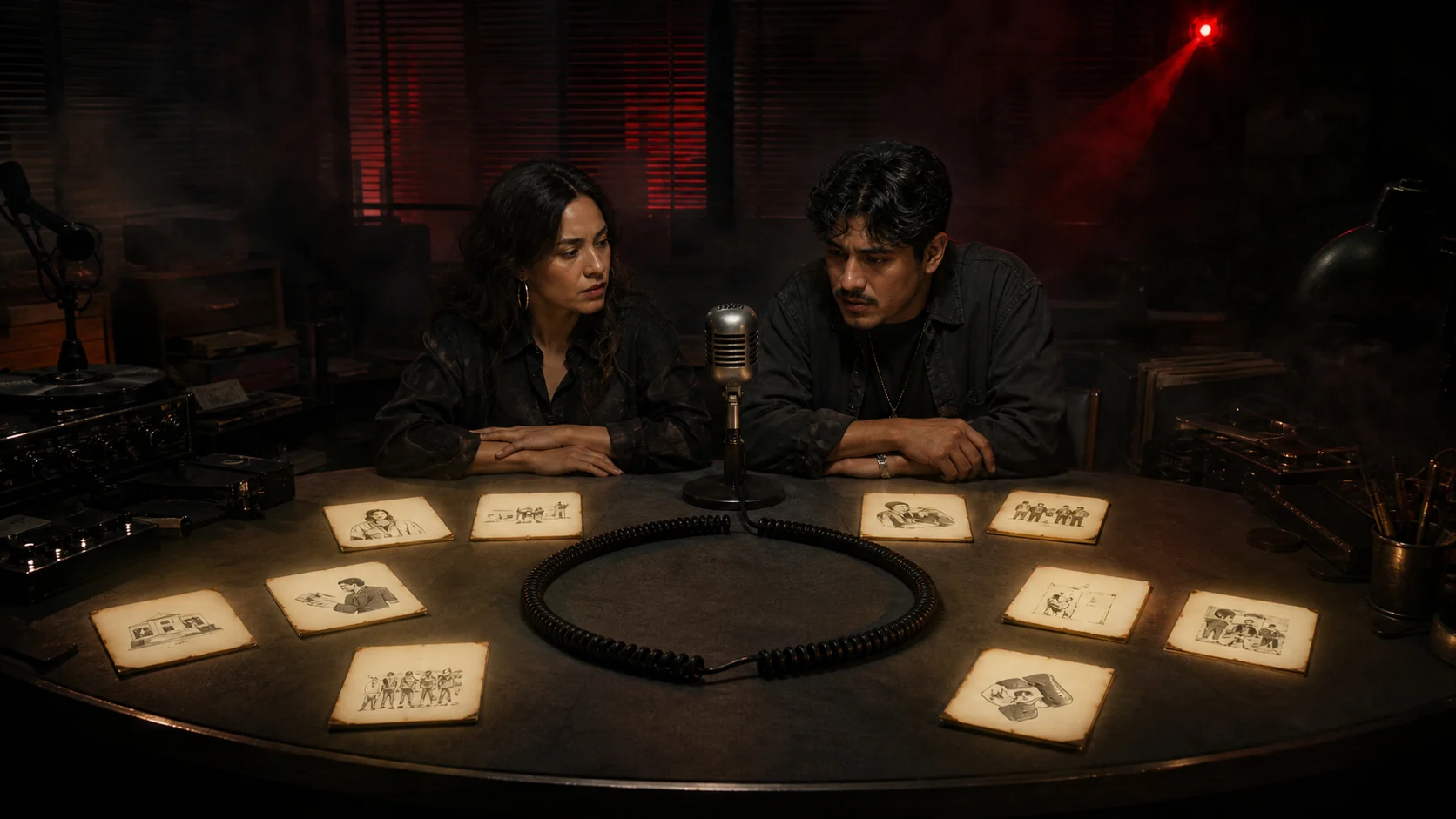
The radio producers face nine illuminated testimony cards as the transmission clock drops below four minutes. Audience choices alter sequence, not performance content.
[ Production method / Documented workflow ]
How the film was made
The record distinguishes authored decisions, bounded machine operations and final human approvals across the production chain.
Writers authored a 412-node testimony graph and defined the moral information available at every choice point before runtime logic was introduced.
Actors rehearsed and filmed every branch in English and Spanish; the system has no authority to generate or alter their performances.
Practical refinery interiors and miniature fire elements were extended with constrained backgrounds tied to a fixed emergency timeline.
A local assembly engine selects only approved cuts, pacing ranges, and points of view while preserving authored cause and effect.
The live mix follows route states through precomposed stems, with radio intelligibility and accessibility cues protected from dynamic changes.
The team stored branch maps, audience-input rules, permissions, runtime logs, model settings, and outcomes from each festival presentation.
“For making collective choice dramatically legible, ethically bounded, and emotionally consequential without reducing civic conflict to a mere branching novelty.”
[ Records / Rights / Provenance ]
Reviewer-ready evidence
The record links every node to its author, rehearsal draft, filmed take, editorial range, and dramatic purpose.
Performer permissions cover all recorded branches and language versions, with explicit limits on recombination and withdrawal procedures.
Runtime logic, local model lineage, constraints, route seeds, and prohibited output states are preserved with the release.
The delivery includes the runtime build, fallback linear edition, picture assets, mix stems, subtitles, access mode, and checksum record.