[ Film / Synopsis ]
A harbour archivist discovers that every demolished shoreline survives as a second, contradictory memory inside the city's night ferries.
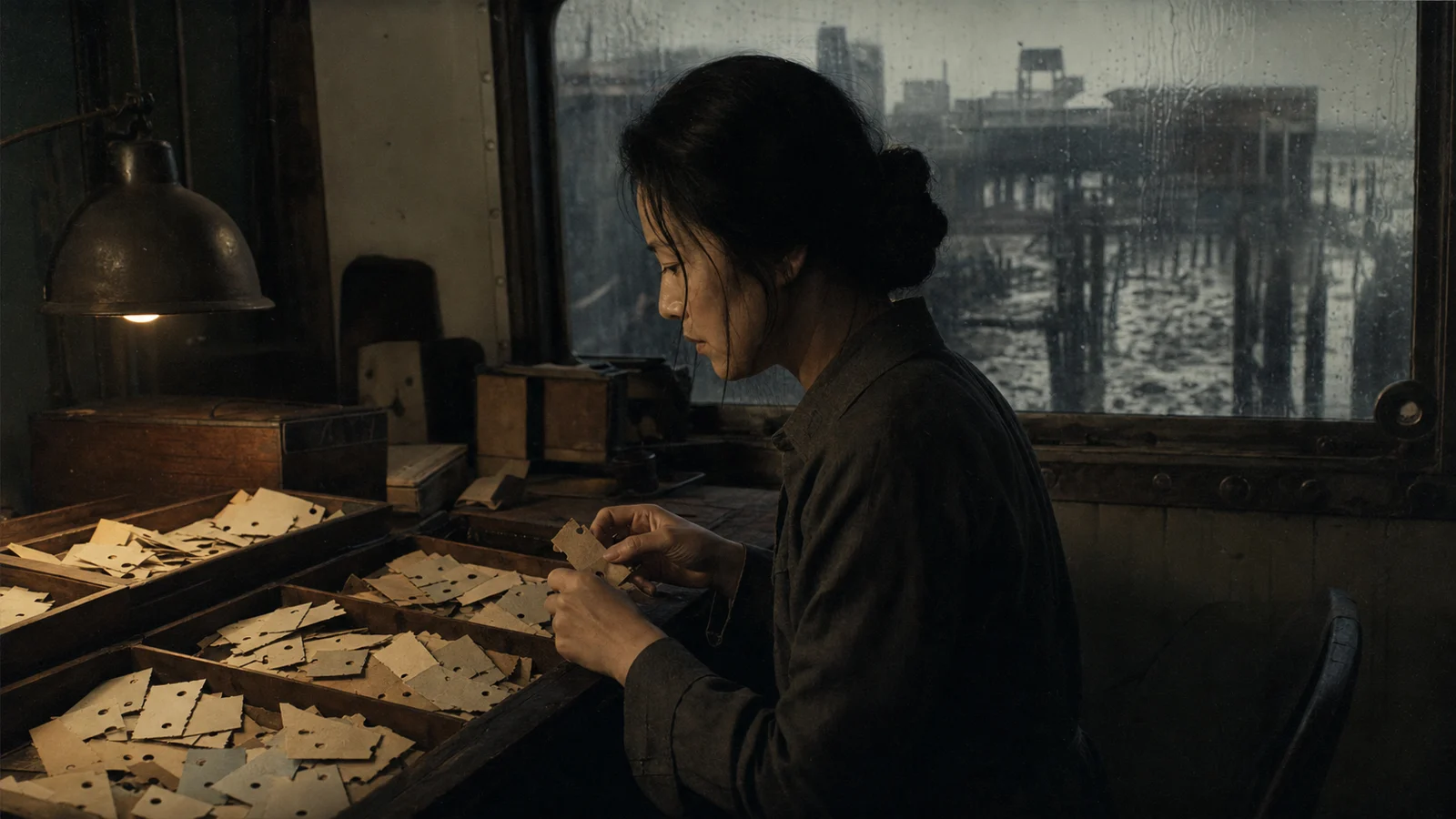
In 2046, municipal archivist Lam Wai discovers that the last night ferries are carrying impossible views of Hong Kong: vanished piers, unbuilt towers, and coastlines remembered differently by every passenger. She begins recording the crossings with Idris, a British sound cartographer searching for traces of his late mother’s years in the city. Their archive grows into a moving map that changes whenever a neighbourhood is erased. As officials prepare to retire the ferry route, Lam must decide which memories deserve a place in the public record and which belong only to those who lived them. Cantonese street testimony, tactile miniature work, and generated urban continuities create two overlapping cities without turning loss into spectacle. The film stays close to hands, voices, ticket stubs, and reflected water while its larger mystery gathers quietly around the harbour.
“For uniting intimate Cantonese performance, civic imagination, and disciplined generative continuity in a harbour epic whose emotional architecture exceeds its technical ambition.”International Jury citation
- Director
- Lau Tsz-ching
- Production entity
- Tideglass Narrative Collective
- Entity type
- AI-native international production collective
- Country / region
- Hong Kong · United Kingdom
- Runtime
- 89 min
- Language
- Cantonese · English
- Format
- 4K · 2.39:1 · 7.1.4 immersive mix
- Genre
- Speculative urban memory drama
- Completed
- 18 June 2026
- Production window
- 14 months
- Festival master / version
- Festival master v1.8 · checksum locked
[ Named authorship / Principal credits ]
Creative team
[ Production entity / Profile ]
Tideglass Narrative Collective
Tideglass Narrative Collective is a Hong Kong-led ensemble formed around multilingual screenwriting, miniature photography, and controlled generative image production. Its members maintain a shared authorship charter that reserves final narrative and editorial decisions for the human creative team.
[ 51% Standard / Assessed creative participation ]
82%
AI participation is assessed across the full chain of authorship, supported by journals, model logs, version histories, stems and finishing records.
[ Capability record / 2026 signal ]
Where this film points
- Long-horizon consistency
- Multilingual synthesis
The film demonstrates feature-length character and city continuity across two languages without surrendering editorial control. It anticipates international productions built around shared story memory rather than isolated generated shots.
Only the filmmakers could decide whose memory carried moral weight and where the final cut should refuse visual spectacle.
[ Last Ferry, Second Shore ]
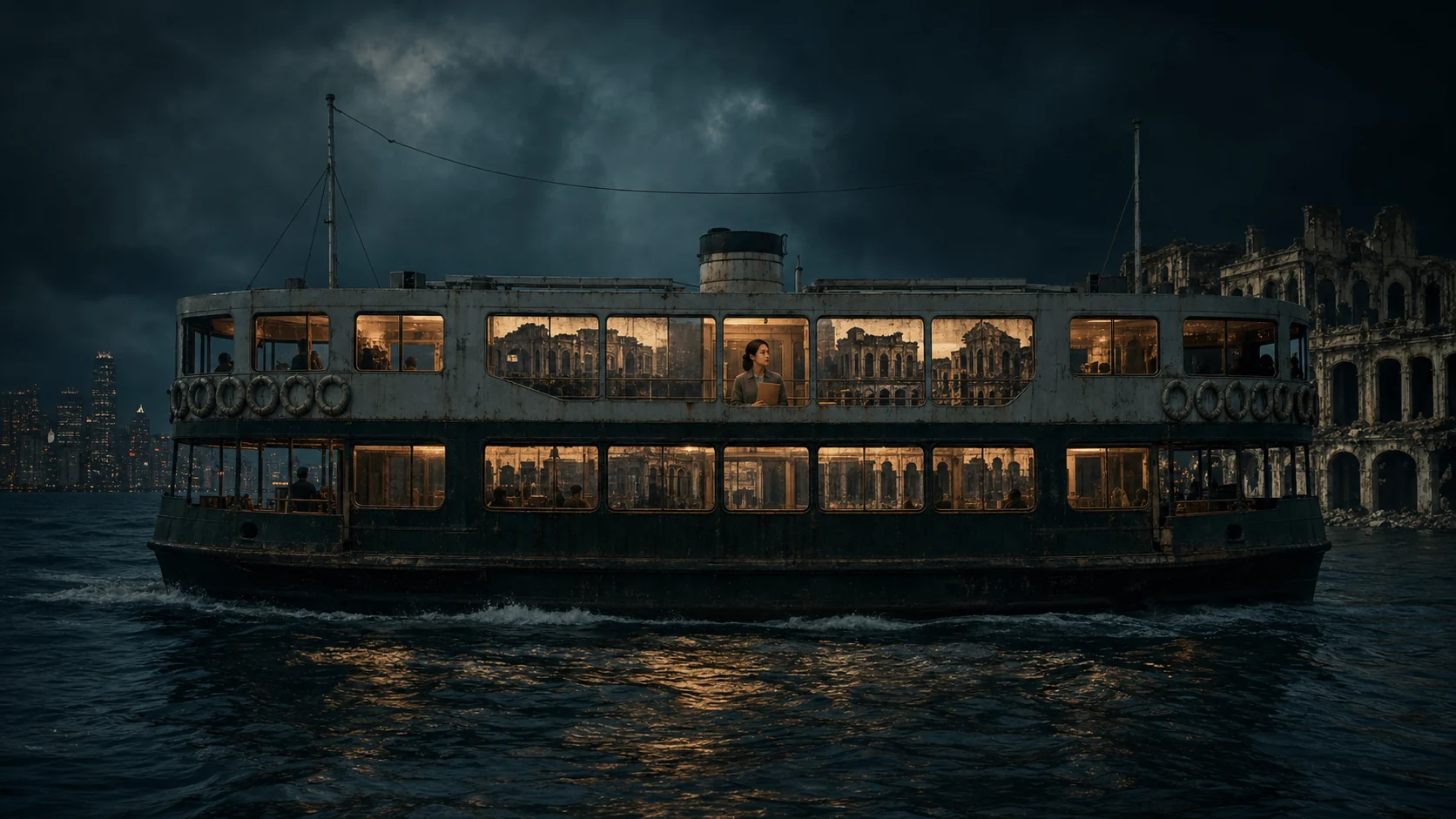
Lam watches a vanished pier appear in the ferry window while the present shoreline remains visible behind her. The reflection is held in one uninterrupted shot.
[ Production method / Documented workflow ]
How the film was made
The record distinguishes authored decisions, bounded machine operations and final human approvals across the production chain.
Writers built a bilingual memory atlas from invented civic histories; a constrained system proposed only links between approved places, dates, and character motives.
Actors performed complete Cantonese and English scenes on practical ferry sets, with timing and emotional interpretation retained from their selected takes.
Miniatures, harbour plates, and lens-matched generated extensions were combined through shot-specific spatial rules and a locked architectural vocabulary.
Human editors shaped the two-city structure, while continuity tools tracked props, eyelines, tidal states, and recurring background actions.
Field recordings from vessels and fabricated waterfronts anchored a spatial mix; synthetic layers were limited to imagined structures and distant memory cues.
The production archived authorship decisions, performer permissions, source plates, generation settings, and every replacement made before the festival master.
“For uniting intimate Cantonese performance, civic imagination, and disciplined generative continuity in a harbour epic whose emotional architecture exceeds its technical ambition.”
[ Records / Rights / Provenance ]
Reviewer-ready evidence
The record maps each sequence to its writers, selected performance takes, editorial decisions, and approved visual rules.
The ledger defines territory, duration, synthetic-use scope, and withdrawal procedures for every performer, voice, image, and contributed source.
The record preserves model lineage, licensed training additions, shot seeds, adapters, and material exclusions without naming commercial products.
The delivery contains the picture master, immersive mix, subtitles, access files, cue sheet, and locked checksum for technical review.