[ Film / Synopsis ]
A mangrove settlement lives through a season that never repeats, generated continuously from bounded ecological rules and remembered human choices.
On an imagined equatorial island, a boat mechanic, a school cook, and two siblings prepare for an annual king tide that never arrives in the same form twice. The work runs continuously, drawing each cycle from a bounded ecology of salinity, sediment, household stores, mangrove growth, and remembered choices. Characters may repair a footbridge, move a classroom, delay a departure, or simply wait; later scenes inherit those decisions without inventing new dialogue. The 67-minute jury edition begins with a stranded bicycle and ends at a communal kitchen, but another presentation could travel through different spaces while respecting the same authored lives. Realtime rendering keeps light, water, and vegetation responsive to the system state. Beneath the technical structure is a quiet ensemble drama about adaptation as repetition, care, and accumulated compromise rather than a single heroic response.
“For advancing procedural cinema into a coherent living work where ecology, character memory, and realtime form remain mutually accountable across every iteration.”International Jury citation
- Director
- Nadira Koh
- Production entity
- Equatorial Loop Research Lab
- Entity type
- Computational ecology research laboratory
- Country / region
- Singapore · Indonesia
- Runtime
- Continuous · 67 min jury edition
- Language
- English · Bahasa Indonesia
- Format
- 4K realtime system · 1.78:1 · adaptive 8-channel mix
- Genre
- Continuous procedural climate cinema
- Completed
- 27 June 2026
- Production window
- 18 months
- Festival master / version
- Festival system v2.4 · jury path locked
[ Named authorship / Principal credits ]
Creative team
[ Production entity / Profile ]
Equatorial Loop Research Lab
Equatorial Loop Research Lab combines computational ecology, realtime image systems, and ensemble dramaturgy for continuous screen works. Its projects use imagined environments so that procedural models can be explored without presenting speculative outcomes as local forecasts.
[ 51% Standard / Assessed creative participation ]
88%
AI participation is assessed across the full chain of authorship, supported by journals, model logs, version histories, stems and finishing records.
[ Capability record / 2026 signal ]
Where this film points
- Procedural world simulation
- Realtime neural rendering
- Agentic narrative systems
The work demonstrates that realtime worlds can sustain remembered choices, ecological causality, and cinematic direction across continuous exhibition. It anticipates screen works released as maintained systems alongside fixed editions.
Human ecologists and dramatists defined the permissible causal world and decided which generated outcomes violated the work’s social meaning.
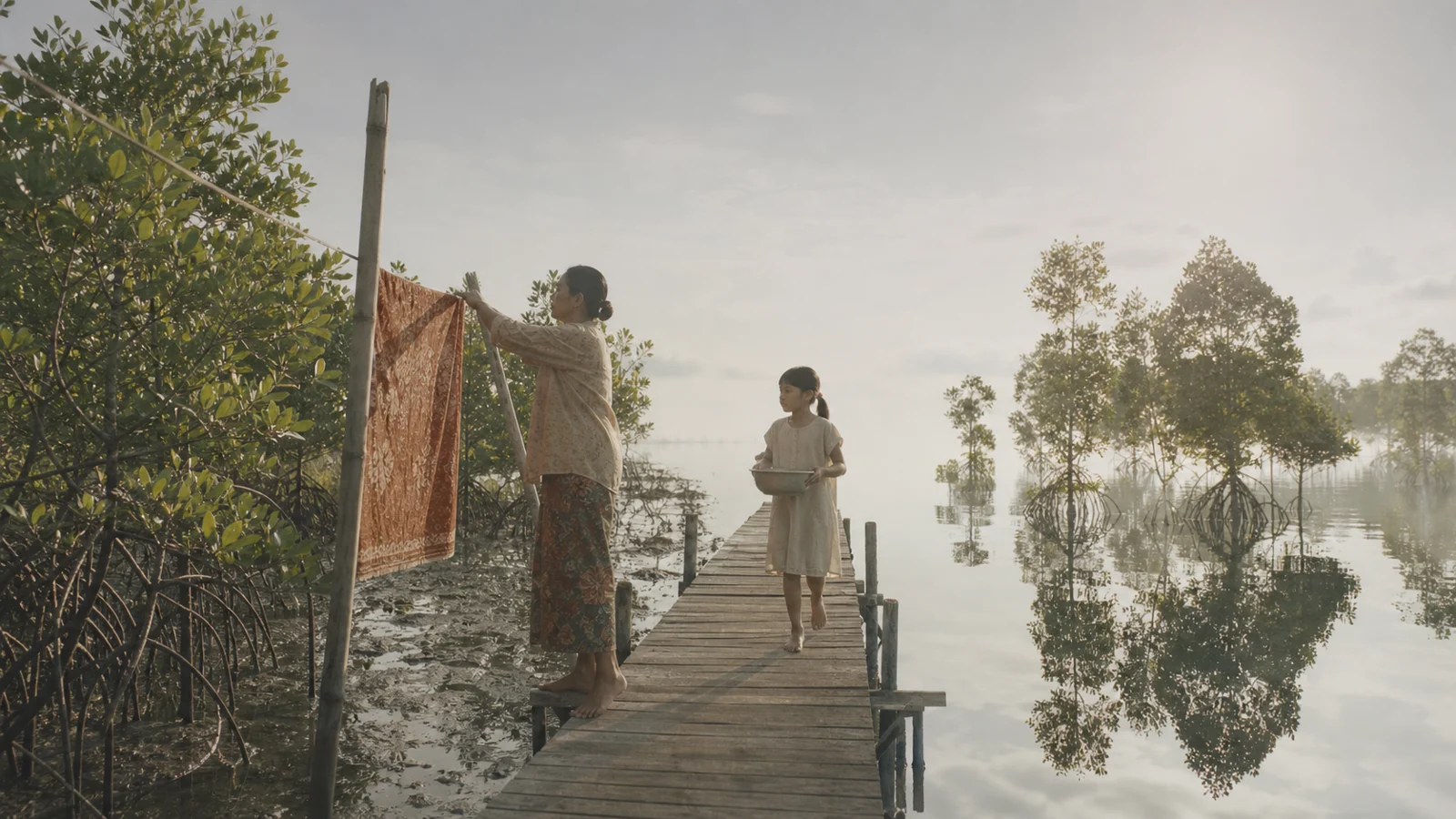
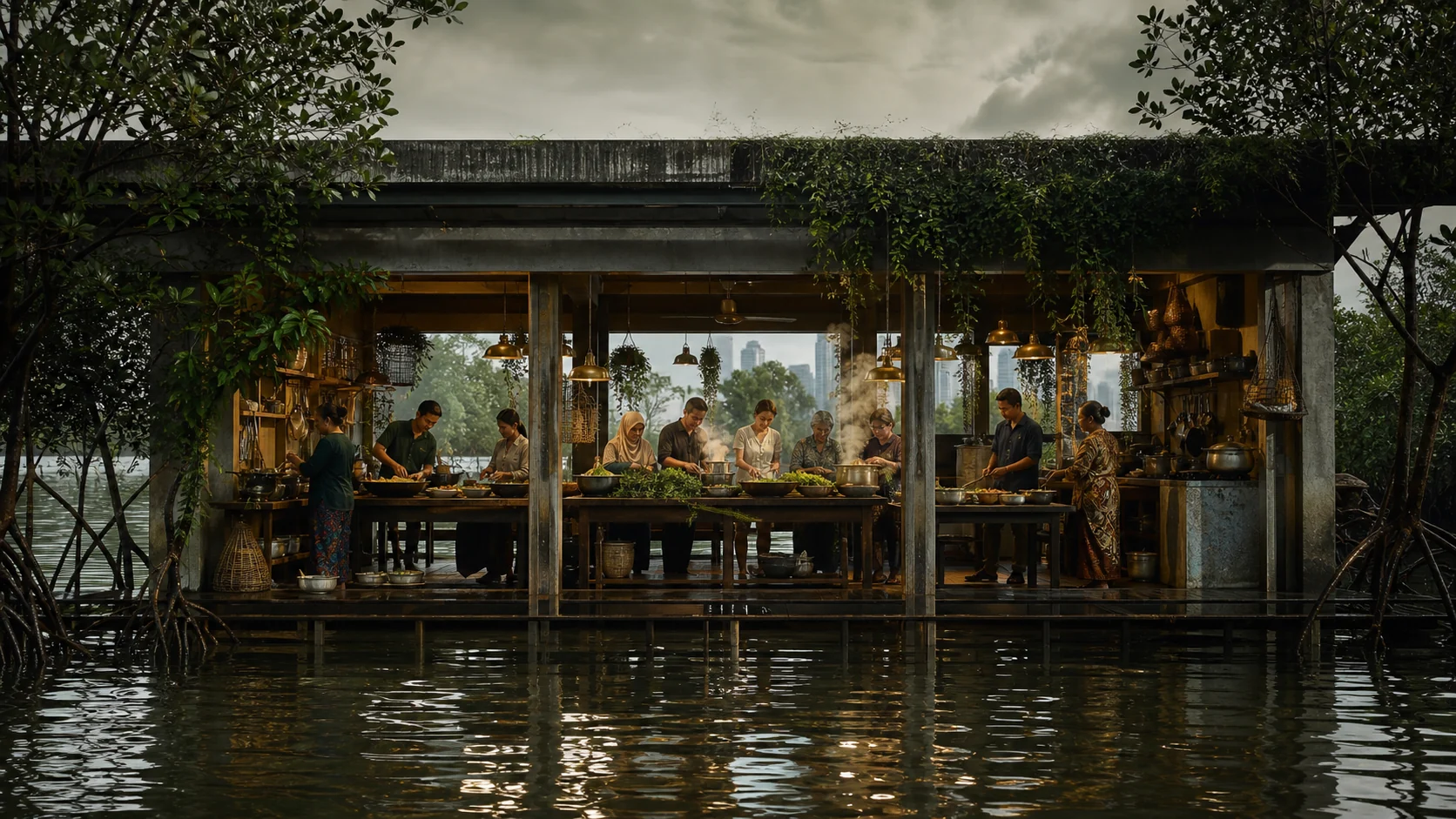
[ Kitchen at the King Tide ]
Steam, reflected water, and mangrove shadows change with the current system state while the performers’ recorded actions retain fixed timing. No two background cycles are identical.
[ Production method / Documented workflow ]
How the film was made
The record distinguishes authored decisions, bounded machine operations and final human approvals across the production chain.
Dramaturgs authored character needs, recurring actions, and consequence rules; the procedural layer can recombine only approved states and transitions.
Ensemble actors recorded modular scenes with matched physical continuity, and human directors selected every permitted emotional transition.
A bounded ecology drives realtime water, vegetation, light, and settlement wear within art-directed ranges and fixed geographic logic.
The live sequencer balances narrative recall, duration, and environmental state while protected scenes preserve orientation and emotional rest.
Adaptive stems follow water height, labour, and location, but dialogue, warning cues, and accessibility information remain fixed.
System versions, state transitions, performance permissions, ecology assumptions, jury-path logs, and master assets are archived together.
“For advancing procedural cinema into a coherent living work where ecology, character memory, and realtime form remain mutually accountable across every iteration.”
[ Records / Rights / Provenance ]
Reviewer-ready evidence
The record maps authored states, protected scenes, performance modules, art-direction ranges, and rejected procedural outcomes.
Permissions define modular performance use, runtime duration, exhibition territory, access conditions, and withdrawal routes.
Ecology rules, rendering lineage, state seeds, parameter bounds, and local inference components are versioned by release.
The package contains the executable system, jury-path capture, fallback master, mix assets, subtitles, access mode, and checksum record.