
[ Film / Synopsis ]
Salt workers build their own census from wage books, footprints, songs, and the names missing from official seasonal records.
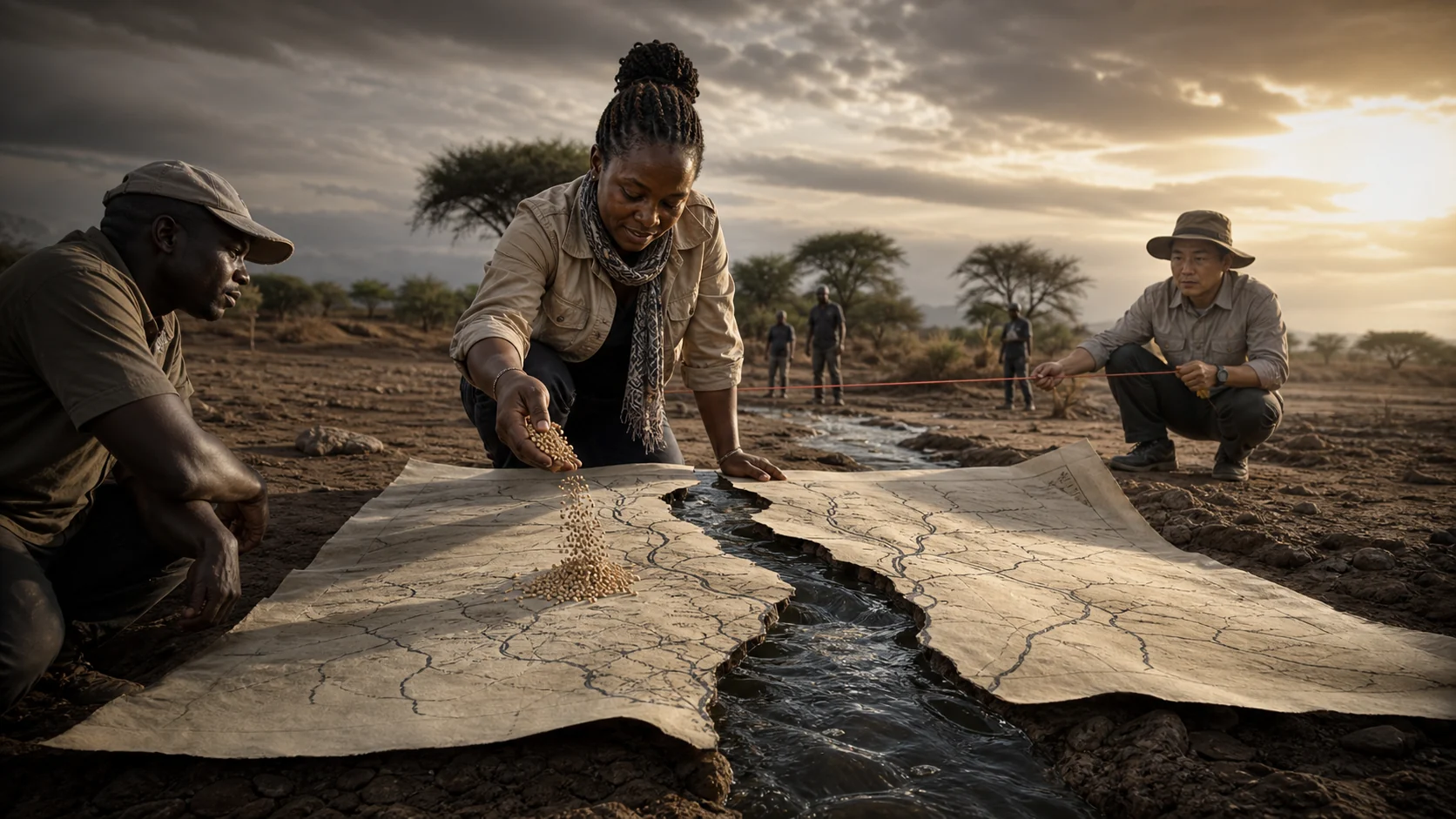
Across a seasonal salt plain, workers notice that official ledgers count harvested tonnes but not the families who move, repair pans, carry water, and lose income when brine levels shift. A community media cooperative begins a different census. Women annotate wage books, children map walking distances, elders record work songs, and crews photograph footprints before the wind erases them. Local tools cluster repeated tasks and help produce Gujarati and Hindi access versions, but residents choose every category, name, and omission. Generated diagrams grow directly from approved records and are projected onto salt beds at night, where the community corrects them in public. The film follows the census through argument, humour, and patient revision rather than presenting data as a finished answer. Its central achievement is a process in which participants retain the materials, the categories, and the right to remove their contribution.
“For placing computational tools under community control and turning overlooked labour records into vivid, collective cinema without extracting ownership from participants.”International Jury citation
- Director
- Ira Devkar
- Production entity
- Tidal Salt Commons
- Entity type
- Community media cooperative
- Country / region
- India
- Runtime
- 71 min
- Language
- Gujarati · Hindi
- Format
- 4K · 1.78:1 · 5.1 mix
- Genre
- Community labour documentary
- Completed
- 30 June 2026
- Production window
- 14 months
- Festival master / version
- Festival master v1.9 · checksum locked
[ Named authorship / Principal credits ]
Creative team
[ Production entity / Profile ]
Tidal Salt Commons
Tidal Salt Commons is a worker-led community media cooperative that produces films, oral histories, and locally held records about seasonal labour. Equipment, source material, and editorial decisions remain under a rotating council chosen by participants.
[ 51% Standard / Assessed creative participation ]
65%
AI participation is assessed across the full chain of authorship, supported by journals, model logs, version histories, stems and finishing records.
[ Capability record / 2026 signal ]
Where this film points
- Multilingual synthesis
- Local reproducible pipeline
- Hybrid capture + generation
The film demonstrates locally controlled analysis and multilingual production that return usable records to participants. It predicts social-impact cinema measured by community ownership of process, not only by representation on screen.
Workers and their council alone defined the census categories, resolved disputes, and decided which names or records could leave the community.

[ Names Projected on Salt ]
Families correct a luminous work map projected across the salt pan after dusk. Each change is spoken aloud before it enters the community record.
[ Production method / Documented workflow ]
How the film was made
The record distinguishes authored decisions, bounded machine operations and final human approvals across the production chain.
Residents defined census categories, story priorities, and exclusions; local tools could group only records approved during open community sessions.
Testimony, songs, demonstrations, and reenacted work routines remained participant-led, with no synthetic replacement of community voices.
Field photography and practical projection carry the film, while generated diagrams derive from approved data and retain visible uncertainty.
A rotating community council reviewed assemblies and could remove a scene, rename a category, or restore disagreement to the cut.
Work songs and location recordings remain source-specific; multilingual support is produced within speaker-approved phrasing and vocal limits.
The cooperative archived contributor choices, source records, category revisions, permissions, model settings, removals, and final delivery files.
“For placing computational tools under community control and turning overlooked labour records into vivid, collective cinema without extracting ownership from participants.”
[ Records / Rights / Provenance ]
Reviewer-ready evidence
The record maps scenes and data categories to community sessions, named decisions, corrections, and retained disagreements.
Contributors control attribution, anonymity, language use, duration, local access, downstream reuse, and withdrawal procedures.
Local analysis lineage, approved datasets, language components, parameter settings, exclusions, and derived diagrams are preserved.
The package contains the picture master, mix, language and access files, community data copy, cue sheet, and checksum record.