[ Film / Synopsis ]
A restorer and a projectionist debate how much of a damaged family film can be rebuilt before repair becomes invention.
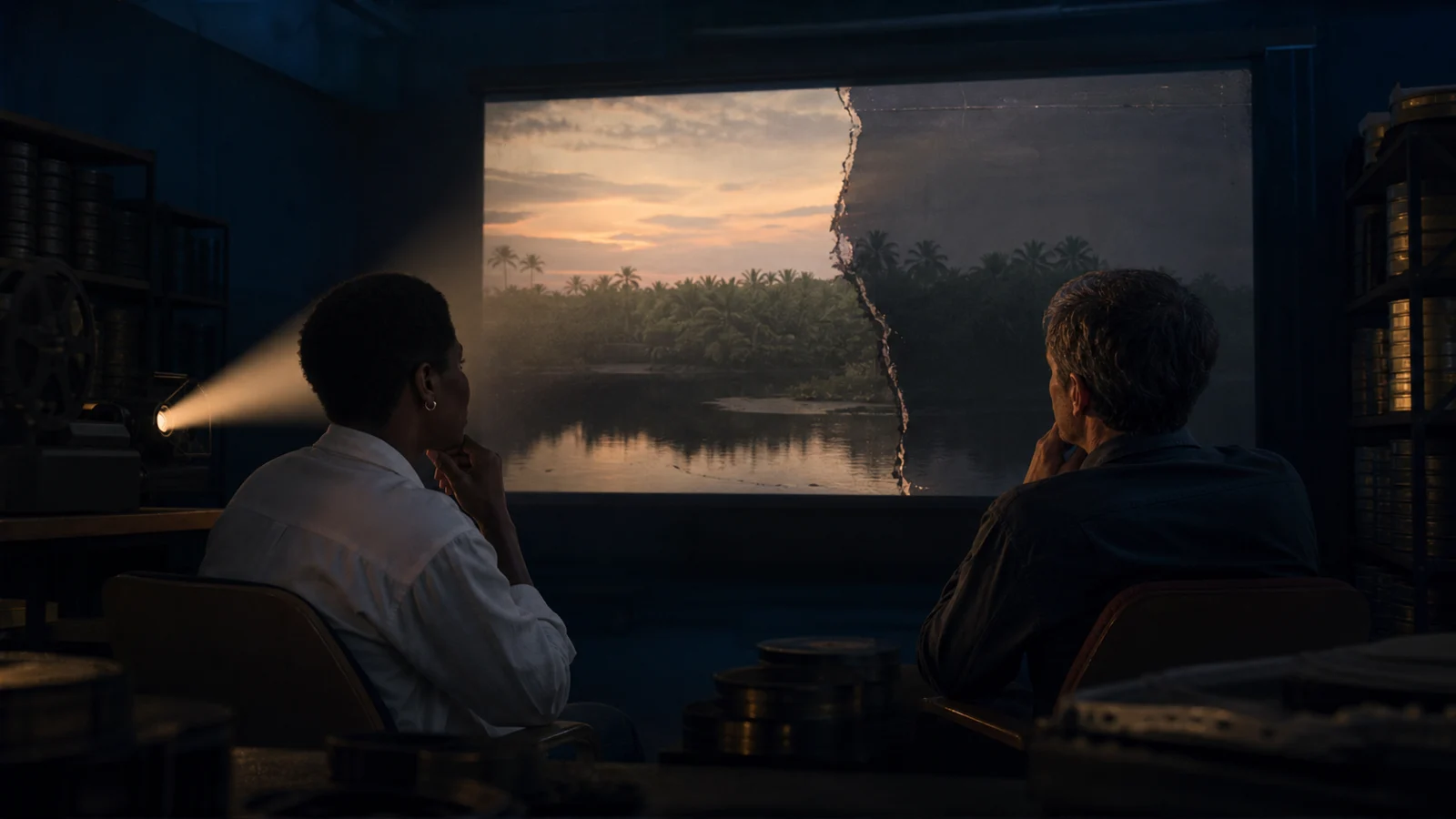
A salt-damaged reel arrives at a small restoration atelier with only thirty-seven readable seconds: a seaside courtyard, children crossing frame, and a woman turning toward the camera before the emulsion disappears. Restorer Elian Rowe believes image reconstruction can recover motion between surviving fragments. Ghanaian projectionist Abena Lartey, whose family donated the reel, insists that absence must remain part of its history. Together they test stabilisation, grain repair, colour inference, and several clearly marked reconstructions, screening each attempt against the physical film. Their conversation becomes the film’s structure. Split frames show source, repair, and rejected invention side by side; no synthetic face is presented as recovered fact. As the final projection approaches, technical success matters less than agreeing where the image should stop. The essay treats collaboration as a chain of accountable choices between craft knowledge, family memory, and bounded computational assistance.
“For making collaboration visible as a sequence of human judgments, refusals, and careful machine assistance rather than a seamless claim of restoration.”International Jury citation
- Director
- Elian Rowe
- Production entity
- True Splice Restoration Atelier
- Entity type
- Independent restoration atelier
- Country / region
- United Kingdom · Ghana
- Runtime
- 62 min
- Language
- English · Ga
- Format
- 4K · 1.37:1 and 1.85:1 · 5.1 mix
- Genre
- Archival creative-process essay
- Completed
- 19 April 2026
- Production window
- 9 months
- Festival master / version
- Festival master v1.4 · checksum locked
[ Named authorship / Principal credits ]
Creative team
[ Production entity / Profile ]
True Splice Restoration Atelier
True Splice Restoration Atelier is an independent workshop for damaged small-format film, family archives, and process-led screen essays. It distinguishes conservation, repair, and interpretive reconstruction in every client record and final presentation.
[ 51% Standard / Assessed creative participation ]
68%
AI participation is assessed across the full chain of authorship, supported by journals, model logs, version histories, stems and finishing records.
[ Capability record / 2026 signal ]
Where this film points
- Hybrid capture + generation
- Neural performance transfer
- Local reproducible pipeline
The film demonstrates restoration systems precise enough to separate repair from speculative reconstruction at frame level. It anticipates archival practice where every synthetic intervention remains reversible and visibly governed by custodians.
The family custodian and restorers alone decided where repair ended, where invention began, and which absences had to remain visible.
[ Where the Emulsion Ends ]
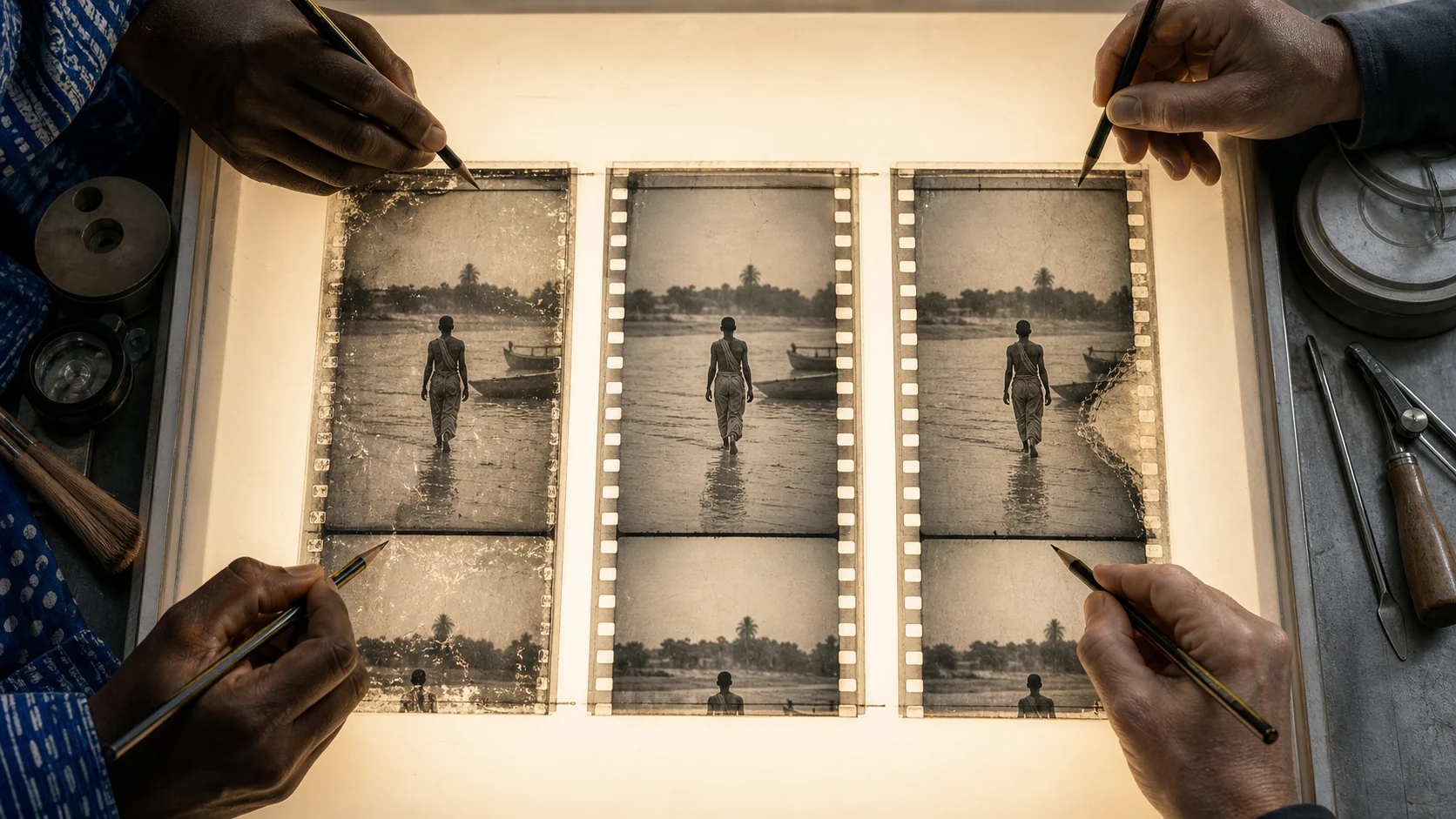
Source film, repaired frame, and rejected reconstruction appear together on a three-panel light table. Human hands stop each version at a different boundary.
[ Production method / Documented workflow ]
How the film was made
The record distinguishes authored decisions, bounded machine operations and final human approvals across the production chain.
The filmmakers structured the essay around disputed frames and recorded decisions, with no automated authority over historical interpretation.
Workshop discussions were filmed as lived exchanges; family readings and projected gestures were selected by participants.
Stabilisation, defect repair, and bounded reconstruction were applied in separate layers so original material and interpretation remain distinguishable.
Human editors placed source, repair, and rejection together, preserving disagreement instead of presenting a frictionless restoration.
Mechanical projector recordings and family-approved ambience accompany silent footage without fabricating undocumented speech.
The atelier archived film scans, family permissions, intervention layers, model settings, rejection reasons, and the exact festival presentation.
“For making collaboration visible as a sequence of human judgments, refusals, and careful machine assistance rather than a seamless claim of restoration.”
[ Records / Rights / Provenance ]
Reviewer-ready evidence
The record separates conservation steps, interpretive trials, family responses, editorial choices, and rejected reconstructions by frame.
Family, archive, voice, and image permissions define restoration scope, synthetic limits, exhibition terms, and withdrawal procedures.
Repair lineage, reconstruction settings, source frames, masks, seeds, and excluded identity operations are preserved.
The delivery contains the essay master, source comparison reel, mix, subtitles, access files, intervention map, and checksum record.