[ Film / Synopsis ]
When an actor withdraws her face from a finished film, its creators must rebuild both the work and their idea of consent.
Three weeks before an in-story film’s premiere, supporting actor Lene Hart invokes a contract clause withdrawing permission for synthetic uses of her face. The producer argues that her transformed appearances are structurally essential; the director believes replacement would destroy the ensemble; Lene insists the agreement was never meant to survive a painful change in her life. A mediator convenes them in a bare screening room where each contested shot is examined by purpose, source, and possible remedy. The production tries reframing, silhouette, reshooting, voice-only presence, and visible absence. Machine assistance helps identify dependencies and rebuild backgrounds, but it cannot decide what counts as fair. As the film changes, so do the relationships around it. The courtroom form remains intimate, focusing on contract language, performance memory, and the practical cost of treating consent as an ongoing production condition.
“For turning withdrawal rights into rigorous drama, demonstrating that responsible synthetic production is a living relationship rather than a signature captured once.”International Jury citation
- Director
- Anke Riedel
- Production entity
- Klarraum Media Ethics Lab
- Entity type
- Film rights research laboratory
- Country / region
- Germany
- Runtime
- 57 min
- Language
- German
- Format
- 4K · 1.66:1 · 5.1 mix
- Genre
- Consent-driven courtroom drama
- Completed
- 8 June 2026
- Production window
- 12 months
- Festival master / version
- Festival master v1.3 · checksum locked
[ Named authorship / Principal credits ]
Creative team
[ Production entity / Profile ]
Klarraum Media Ethics Lab
Klarraum Media Ethics Lab develops scripted case studies and production methods for revocable performance permissions. Its work combines screen drama with practical rights design and keeps legal responsibility with named human decision makers.
[ 51% Standard / Assessed creative participation ]
63%
AI participation is assessed across the full chain of authorship, supported by journals, model logs, version histories, stems and finishing records.
[ Capability record / 2026 signal ]
Where this film points
- Consent-bound voice & likeness
- Local reproducible pipeline
The film demonstrates production systems capable of propagating a withdrawn permission through a finished timeline. It forecasts revocability becoming a practical design requirement for synthetic performance.
Only the actor and accountable production leaders could negotiate consent, accept the cost of withdrawal, and decide what repair remained ethical.
[ Shot Twenty-Seven Withdrawn ]
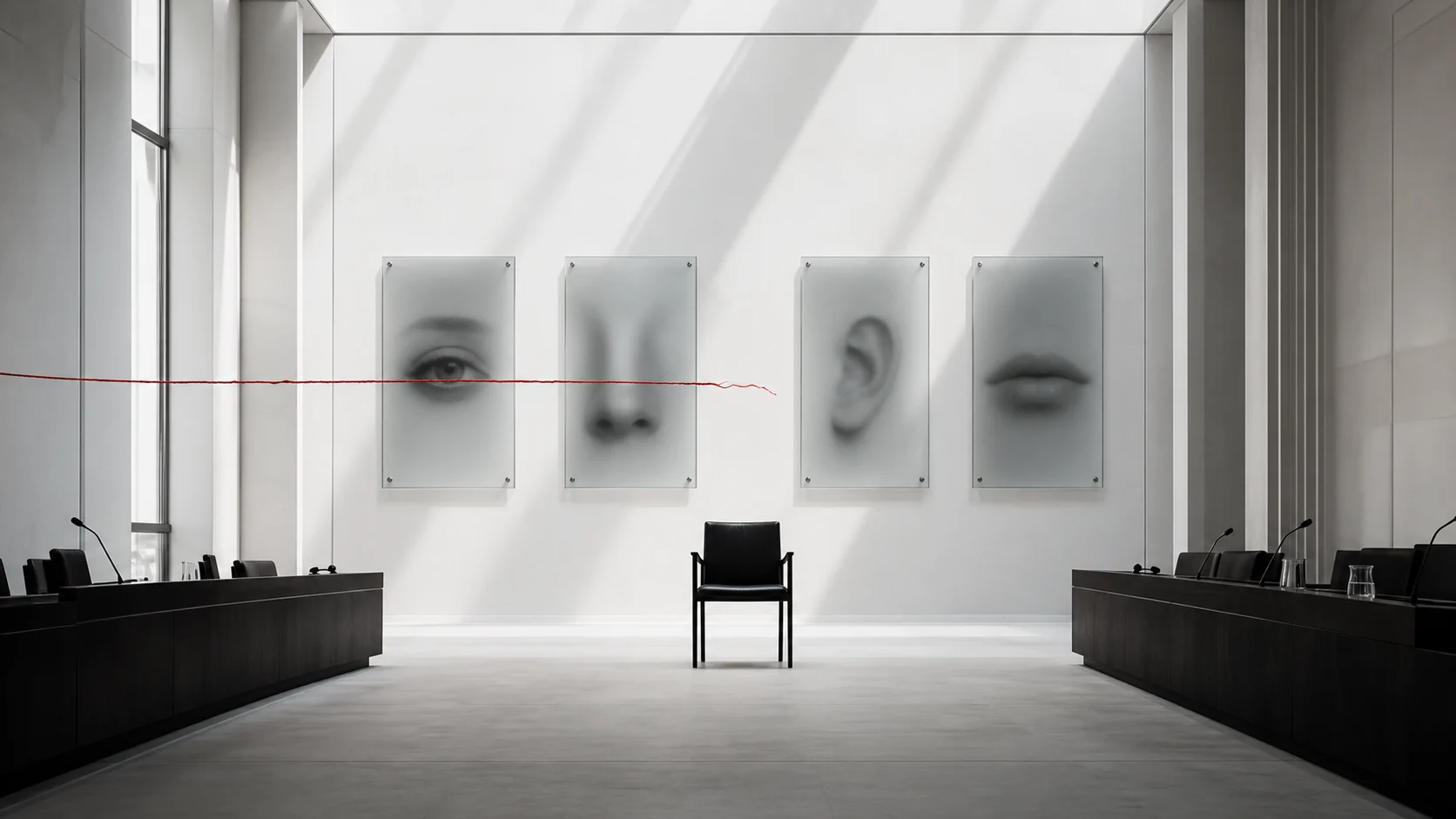
Lene’s original performance is represented by an empty chair and a moving eyeline diagram while the team considers four replacement strategies. The absence remains explicit.
[ Production method / Documented workflow ]
How the film was made
The record distinguishes authored decisions, bounded machine operations and final human approvals across the production chain.
Writers built the drama from scripted contracts, shot dependencies, and competing remedies, with every legal position assigned to human characters.
Actors performed the full mediation, and each synthetic-use permission could be narrowed or withdrawn during production.
Dependency tools located affected shots; practical reframing and bounded background reconstruction replaced withdrawn material without recreating the actor.
Editors tested remedies as dramatic choices and retained visible discontinuities where concealment would weaken the film’s ethical premise.
Dialogue remains performance-led, while licensed room reconstruction and restrained cues clarify changes without simulating withdrawn speech.
The lab archived permission versions, withdrawal dates, affected-shot maps, remedy decisions, model settings, and final release boundaries.
“For turning withdrawal rights into rigorous drama, demonstrating that responsible synthetic production is a living relationship rather than a signature captured once.”
[ Records / Rights / Provenance ]
Reviewer-ready evidence
The record links each contested shot to its dramatic purpose, original source, proposed remedies, and final human decision.
Permissions are role-specific, time-bounded, transform-specific, renewable, and paired with clear withdrawal procedures and downstream actions.
Dependency analysis, reconstruction lineage, source masks, settings, exclusions, and deleted identity materials are versioned.
The package includes the picture master, mix, subtitles, access files, rights-state map, affected-shot index, and checksum record.